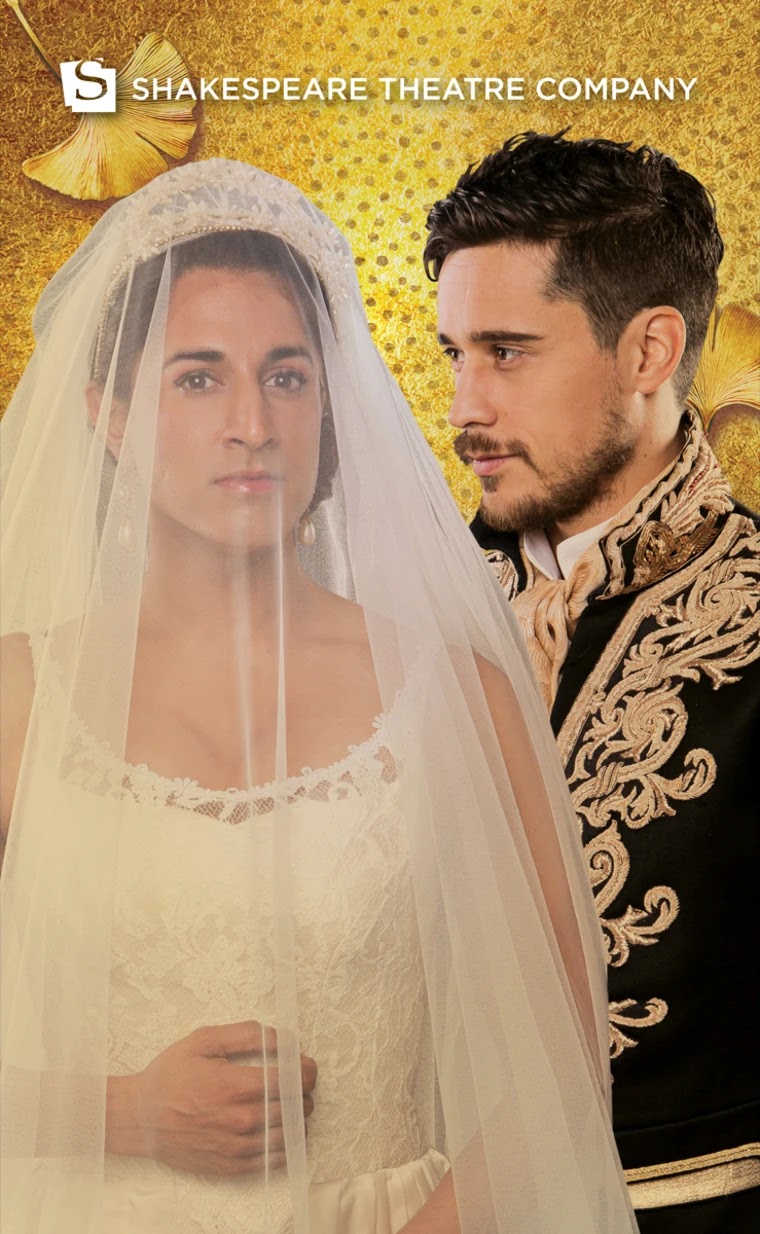
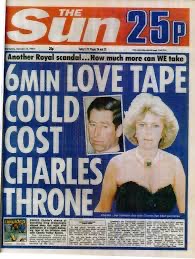
On the contrary, as we inevitably see, any “real” human beings, assigned by heredity to the daunting task of incarnating (but without thinking or feeling) the ideal “forms” of The Crown, often waste a great deal of money and time in constitutionally useless or irrelevant activities, stuff that keeps them busy and, frankly, non-suicidal. In their trivial and human pursuits, they even, sometimes, bring opprobrium upon themselves and thus make people—especially those who read The Sun—lose respect for The Crown itself.
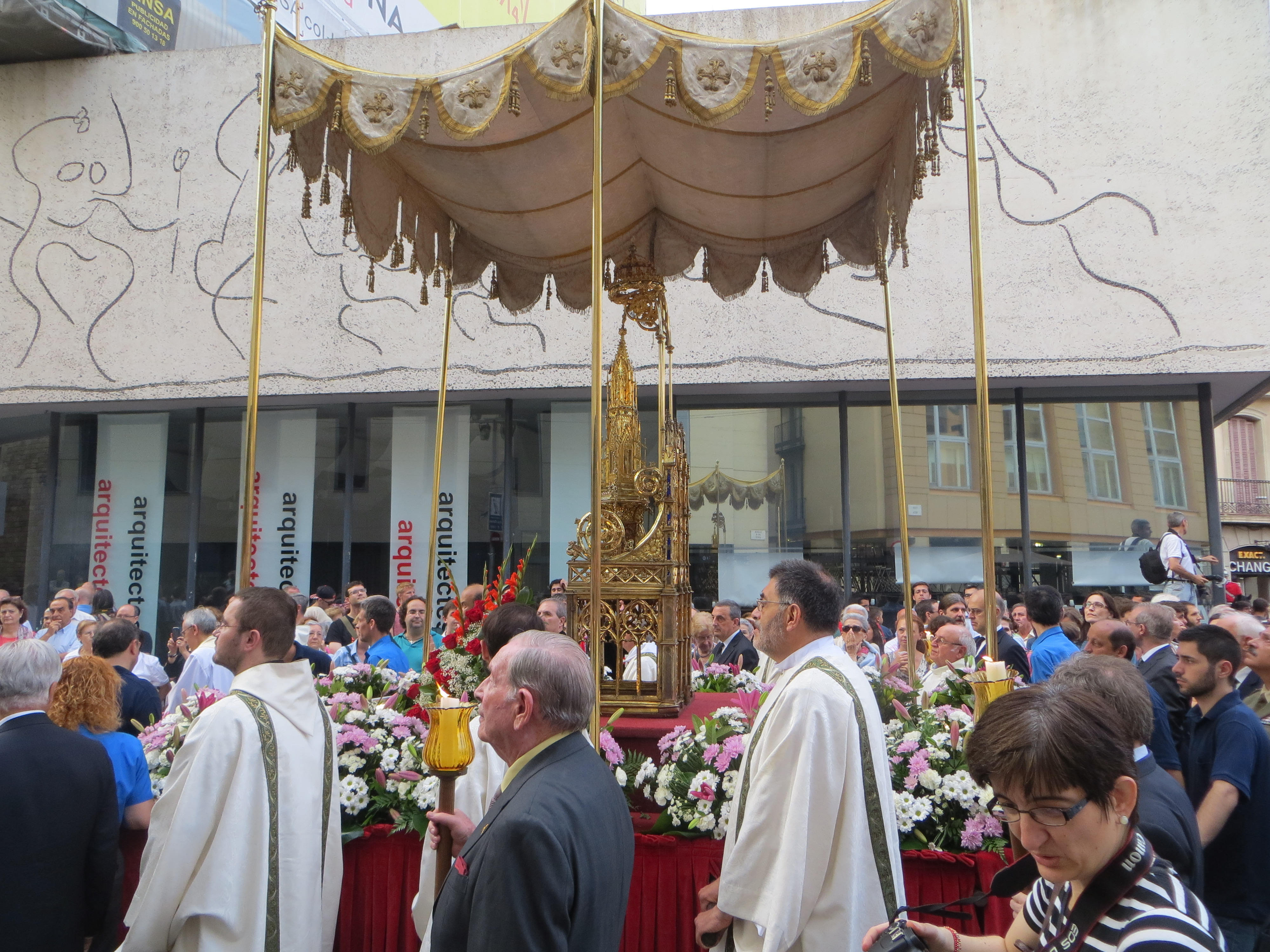
I’d like to suggest that the solution to this dilemma might be illustrated in the photo at the top: eliminate the particular, mortal player (i.e., in platonic terms, the “accidental” properties of The Crown) and replace this imperfect vessel with something having no fleshly body at all—only the “essential” properties. I took this picture of a float in a grandiose Corpus Christi procession in Barcelona. You will note that the object for veneration is—not a material, pinchable Jesus—but rather an idealized “Body of Christ,” encapsulated in a consecrated wafer, itself enshrined in a bejeweled tabernacle, and the whole edifice mounted on an gilded throne beneath a brocade canopy. At various moments along the parade route, certain liturgical ceremonies were performed by the priests—in particular, I recall, the entire assemblage was perfumed with incense as a sign of veneration. Not so much of a particular being—but of the idealized Corpus Christi somehow abiding in that metal monstrance.


I’d like to suggest that the solution to this dilemma might be illustrated in the photo at the top: eliminate the particular, mortal player (i.e., in platonic terms, the “accidental” properties of The Crown) and replace this imperfect vessel with something having no fleshly body at all—only the “essential” properties. I took this picture of a float in a grandiose Corpus Christi procession in Barcelona. You will note that the object for veneration is—not a material, pinchable Jesus—but rather an idealized “Body of Christ,” encapsulated in a consecrated wafer, itself enshrined in a bejeweled tabernacle, and the whole edifice mounted on an gilded throne beneath a brocade canopy. At various moments along the parade route, certain liturgical ceremonies were performed by the priests—in particular, I recall, the entire assemblage was perfumed with incense as a sign of veneration. Not so much of a particular being—but of the idealized Corpus Christi somehow abiding in that metal monstrance.
I don’t know how many of the procession’s observers were devout Catholics (I, for instance, was not), but really, it doesn’t matter: we were all impressed by the pomp and solemnity of the proceedings and we were all thus invited to recall and reflect upon the essential FORMS of Christian belief that were here represented in an impersonal and metaphoric artefact.

That is what I propose for Britain. Ditch the actual royal family—they’re mostly a tedious anachronism who tend to piss people off (true, Elizabeth tried mightily to be an entirely robotic vessel, but even she had an annus horibilis). Only, by all means, keep The Crown—i.e., all the ceremonies, conventions and rituals that connect (almost sacramentally) the British people with their constitutional heritage. But do as the Catholics have done: replace the “accidental” body of a king with a vaguely tangible, but impersonally metaphoric, representation of the king’s meaning. Perhaps, for example, in lieu of a rather dorky human, an actual crown —St. Edward’s crown, say—could be incensed, anointed, placed upon the Coronation Chair and sworn allegiance to. (Please, though, only one “Crowning of the Crown” per generation.) And at the opening of Parliament, this artefact representing the Constitution could be placed on the throne, and the actual dreadful King’s Speech could be read by the person guilty of writing it—the Prime Minister in person. Black Rod and all that—well, it’s sacramental. Keep it. It points to basic British dogma—like the bell in the Mass points to basic Catholic belief.
And keep the State Coach to ferry about this sacramental crown. It’s more impressive than a float in a Corpus Christi parade, IMO.

P.S. This post is entirely tongue-in-cheek and NOT intended to offend. I am not British, and I have absolutely NO qualifications for proposing political reforms in the U.K. I was merely struck by how tidily the Catholics have managed to celebrate the essence of their heavenly kingdom by tucking it beneath the appearance of an innocuous piece of bread: no personal presence of any king (though I do remember the insistence that he is still “really “ there.) I just wondered if the British couldn’t do likewise and frustrate forever the tabloid press. What possible scandals could they find in the conduct or opinions of an innocuous piece of metal, even if it is The Crown?